Quick Overview
Short answer: WhatsApp chatbot cost in Malaysia can start around RM1,500 to RM5,000 for a tightly scoped FAQ or lead-capture setup, move to RM5,000 to RM15,000 for an API-based qualification flow with integrations, and exceed RM15,000 when the project involves AI, several departments or multiple business systems.
These are editorial planning bands, not official Meta charges or a fixed DigitalBina quotation. Your actual total combines implementation work, WhatsApp Business Platform message charges, any solution-provider fees, integrations, maintenance and internal operating time.
- Budget for setup and ongoing use
- Start with one measurable workflow
- Plan human handoff before launch
In this guide
- WhatsApp chatbot cost at a glance
- The seven costs inside a chatbot project
- Three Malaysian budgeting scenarios
- Hidden costs quotations often miss
- How to estimate your budget
- Consent, privacy and human handoff
- Frequently asked questions
WhatsApp chatbot cost in Malaysia at a glance
| Scope | Planning range | Typical fit and cost drivers |
|---|---|---|
| Focused starter | RM1,500 to RM5,000 | FAQs, lead capture or appointment interest. Driven by flow count and testing. |
| Integrated workflow | RM5,000 to RM15,000 | Qualification, booking, CRM or team routing. Driven by APIs and data fields. |
| Advanced automation | RM15,000+ | Multi-team, multilingual or AI workflows. Driven by architecture, security and monitoring. |
The table is a budgeting framework, not a market price survey. A short but technically difficult integration may cost more than a long FAQ flow. A provider should confirm the scope before quoting.
First decide what you mean by a WhatsApp chatbot
Three different tools are often discussed as if they are the same:
- WhatsApp Business App: A small team answers chats manually and uses features such as greeting messages, quick replies, labels and a catalogue.
- Rule-based automation: The customer chooses from guided options, supplies details and reaches a defined outcome or human team.
- API-based or AI-assisted chatbot: The WhatsApp Business Platform connects conversations with workflows, databases, CRM tools, booking systems or an approved knowledge source.
The free Business App may be enough when message volume is manageable and one person can respond reliably. A structured chatbot becomes useful when enquiries are repetitive, response time is inconsistent, several staff share one channel, or information must move into another system.
DigitalBina’s AI chatbot and WhatsApp automation service is the commercial owner for implementation enquiries. This guide remains a budgeting resource rather than a replacement service page.
The seven costs inside a WhatsApp chatbot project
1. Discovery and workflow design
A useful chatbot starts with the conversation, not the software. The provider needs to map:
- why customers message;
- which questions can be answered safely;
- which details should be collected;
- what qualifies a useful lead;
- where each enquiry should go;
- when a human must take over; and
- what should happen when the chatbot does not understand.
Skipping this step often produces a bot that looks functional in a demo but frustrates real customers. Discovery, copy planning and exception mapping are part of the implementation cost.
2. WhatsApp Business Platform message charges
Meta charges businesses on a per-delivered-message basis, with rates varying by the recipient’s market and message category. The current categories are marketing, utility, authentication and service. Meta states that service messages are not charged, and utility messages sent in response to users are also not charged. A user message opens a 24-hour customer-service window.
Meta also says that when a customer starts a conversation from a click-to-WhatsApp ad or Facebook Page call-to-action button, messages are not charged for the following 72 hours. Rates and rules can change, so check the official WhatsApp Business Platform pricing page when preparing the budget.
Do not calculate message cost from total chat lines alone. Estimate the number of delivered template messages by category, recipient market and monthly volume.
3. Solution-provider, hosting or platform fees
Some businesses connect directly to Meta’s Cloud API. Others use a third-party platform or solution provider that adds an inbox, chatbot builder, user seats, analytics, support or integrations.
Possible recurring charges include:
- platform subscription;
- additional agent seats;
- automation or workflow usage;
- AI model or knowledge-search usage;
- hosting and logging;
- integration connectors; and
- premium support.
Ask whether the quoted fee includes Meta’s message charges or whether those charges are billed separately.
4. Conversation design and approved message templates
Business-initiated conversations outside the customer-service window use approved message templates. Their category and purpose affect how they can be used and charged.
The build may include template planning, submission, revisions and multilingual versions. Bahasa Malaysia and English should not be added as word-for-word copies without checking how customers actually ask questions in each language.
5. Website, CRM and business-system integrations
A chatbot that only replies is simpler than one that must create a lead, check a booking slot, update an order, notify a salesperson and write the outcome into a CRM.
Integration cost depends on:
- whether the target system has a usable API;
- authentication and permissions;
- required fields and validation;
- duplicate handling;
- error recovery;
- rate limits;
- testing environments; and
- who owns each system.
For broader process work, the AI business automation service covers workflows that continue beyond the chat itself.
6. AI knowledge and response controls
An AI-assisted chatbot may search approved business information and generate a suitable response. That adds work beyond connecting a language model.
The team needs to prepare and maintain the knowledge source, define prohibited answers, control uncertainty, log failures and decide when the bot should stop and transfer the conversation. Model usage may also create a variable recurring cost.
AI is not necessary for every project. A deterministic flow is often safer for prices, appointments, eligibility, order details and other information that must follow a clear rule.
7. Testing, maintenance and improvement
The launch budget should include testing on real devices and realistic conversation paths. Ongoing work may include:
- reviewing failed or abandoned paths;
- updating approved answers;
- adjusting lead questions;
- monitoring integrations;
- replacing expired credentials;
- checking message-template status;
- training staff; and
- keeping the human handoff reliable.
Three Malaysian budgeting scenarios
Local service business: capture and route enquiries
A renovation company in Selangor may need the chatbot to ask for property type, location, service required, preferred timing and photos before routing the enquiry to the right estimator.
The main cost is workflow design, media handling, lead storage and team routing. AI may add little value if the qualification questions are fixed.
Clinic or appointment business: answer safely and hand off
A clinic may want opening hours, branch selection, appointment interest and a clean handoff to reception. The chatbot should not make unsupported medical decisions or collect unnecessary sensitive information.
The budget should allow for stricter response controls, privacy review, staff escalation and careful testing. This article is not legal or healthcare compliance advice.
Ecommerce business: order updates and product questions
An ecommerce team may combine product questions, delivery status, order confirmation and abandoned-cart reminders. Costs rise when the bot must connect to inventory, payment, courier or order-management systems.
Marketing, utility and service messages have different purposes under WhatsApp’s pricing model. The team should map each message type before estimating recurring charges.
Hidden costs that quotations often miss
A low setup fee can become expensive when the scope excludes the work needed to operate the system. Confirm whether the quotation covers:
- Meta Business setup and verification support;
- phone-number migration or coexistence requirements;
- conversation copy in BM and English;
- message-template preparation;
- CRM, booking or spreadsheet integration;
- data cleanup and field mapping;
- testing and launch support;
- staff accounts and training;
- monthly monitoring;
- change requests;
- provider platform fees;
- Meta message charges; and
- ownership of accounts, workflows and documentation.
- Top enquiry reasons
- Details to collect
- Required languages
- Systems to connect
- Human handoff owner
How to estimate your own chatbot budget
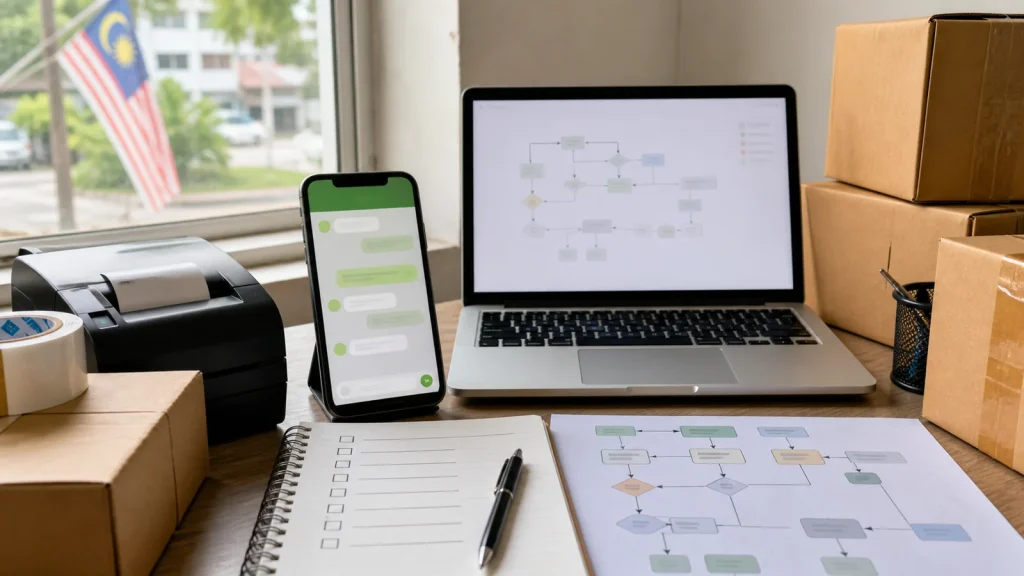
Start with a one-page scope before speaking to providers:
- Count the five to ten most common reasons customers message you.
- Mark which answers are stable and which require a staff member.
- List the details the chatbot genuinely needs to collect.
- Decide where a qualified enquiry must be saved or sent.
- Estimate monthly inbound enquiries and outbound template messages.
- Identify required languages.
- Define the human handoff, owner and response hours.
- List systems that need to connect.
- State what reporting would help you improve the workflow.
This preparation makes quotations easier to compare. It also prevents providers from pricing two completely different systems under the same phrase, “WhatsApp chatbot.”
What a clear quotation should show
| Quotation area | What should be clear |
|---|---|
| Scope and platform | Included flows, languages, provider, account ownership and exclusions |
| Message charges | Who pays Meta charges and how usage will be monitored |
| Integrations | Systems, fields, authentication, error handling and limitations |
| AI | Knowledge source, usage charges, response boundaries and fallback |
| Compliance and handoff | Opt-in, privacy, retention, escalation path and response hours |
| Delivery | Discovery, build, testing, training, launch and documentation |
| Support | Warranty, maintenance scope, ownership and change rates |
Avoid comparing only the setup total. Compare what is included, what remains manual, who owns the accounts and what happens when something fails.
Consent, privacy and human handoff are part of the build
WhatsApp’s Business Messaging Policy says a business may contact people only after receiving their mobile number and opt-in permission. It also requires businesses to respect opt-out requests. Outside the 24-hour customer-service window, business-initiated messages must use approved templates. Automation must provide a clear escalation route, such as transfer to a human agent, phone, email or web support.
Read the current WhatsApp Business Messaging Policy before launch.
Malaysia’s Personal Data Protection Department explains that people should be told why their data is processed and may withdraw permission or prevent direct-marketing processing. Its data-subject rights guidance is a useful starting point.
Your business remains responsible for its notices, permissions, retention, security and lawful use. Confirm legal or regulated-industry requirements with a qualified professional.
When the WhatsApp Business App is enough
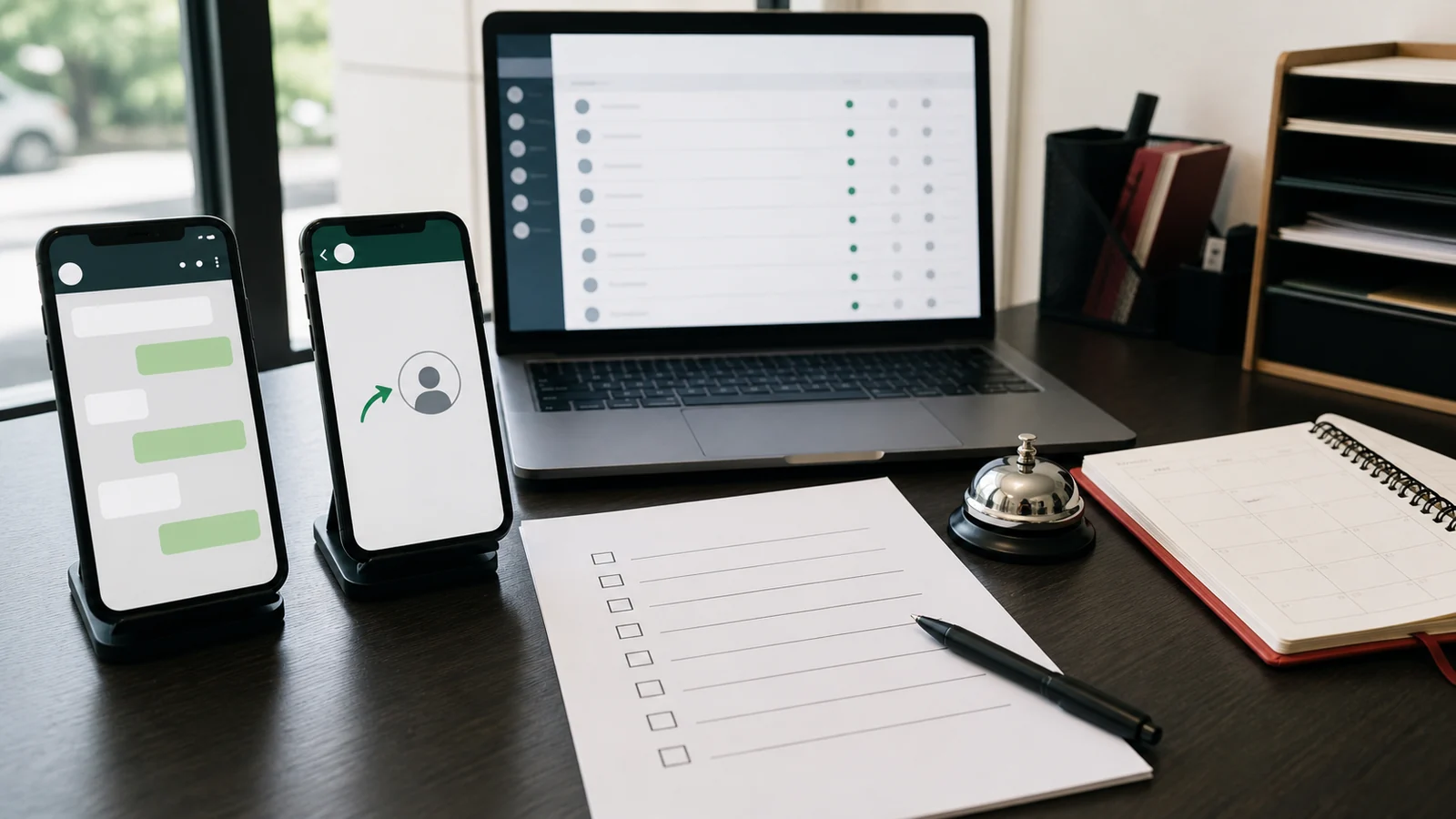
Stay with the Business App when:
- enquiry volume is manageable;
- one small team can respond consistently;
- quick replies and labels solve the main problem;
- no system integration is needed; and
- manual follow-up is still reliable.
Do not buy automation merely because it sounds advanced. First fix unclear offers, missing website information and poor staff ownership.
When a chatbot becomes worth considering
A structured setup may be justified when:
- good enquiries arrive outside operating hours;
- staff repeatedly answer the same questions;
- leads are lost because key details are missing;
- several branches or departments share the channel;
- follow-up depends on manual copying;
- customers need consistent status or appointment information; or
- management cannot see where conversations stall.
The business case should connect automation to a measurable operating problem, not simply the number of messages sent.
How DigitalBina scopes WhatsApp chatbot projects
DigitalBina begins by mapping the customer questions, qualification logic, data destination and human handoff. The proposed setup can then be limited to the smallest workflow that solves the problem, with platform charges and exclusions separated from implementation work.
Depending on scope, the work may include conversation planning, website entry points, WhatsApp Business Platform setup, approved templates, BM and English flows, CRM or spreadsheet handoff, testing, analytics guidance and team training. Complex integrations or AI features are quoted only after the systems and risks are understood.
You can also review DigitalBina’s website and digital service pricing or send the project requirements for a scoped recommendation.
Frequently asked questions
Is the WhatsApp Business App free?
Yes. The app itself does not require a custom chatbot build. Costs arise when you add staff time, third-party tools, the WhatsApp Business Platform, integrations or custom automation.
Does Meta charge for every chatbot reply?
No. Charges depend on the message category, recipient market and current pricing rules. Service messages and some utility replies are free, so check Meta's latest rate card before budgeting.
Can I keep my existing WhatsApp number?
Sometimes. It depends on your current account and implementation route. Confirm migration, coexistence and possible downtime before approving the project.
How long does a WhatsApp chatbot take to build?
A focused flow can take a few weeks. Integrations, approvals, multilingual content, AI preparation and stakeholder testing can extend the schedule.
Do I need AI in the chatbot?
No. Rule-based flows are often safer for predictable answers and actions. AI is useful when customer wording varies or the approved knowledge source is broad.
Who owns the chatbot and WhatsApp account?
Your quotation should name the owner of the Meta assets, phone number, provider account, workflows, documentation, source code where applicable and exported data.
Budget for the workflow, not only the chatbot screen
The most useful WhatsApp chatbot cost Malaysia estimate separates setup, message charges, provider fees, integrations and ongoing operation. Start with one measurable workflow, keep the handoff human, and expand only after the first version proves useful.
Need a clear scope?
Tell us your workflow and systems. We will recommend a practical starting point.