
Quick Overview
A small business website in Malaysia needs more than a nice homepage. It should explain what you offer, build trust fast, work well on mobile, make WhatsApp or enquiry actions obvious, and cover the SEO and privacy basics that customers and search engines now expect.
Quick Overview
A small business website in Malaysia needs six things working together: a clear goal, the right pages, real trust signals, a smooth mobile and WhatsApp experience, basic SEO and AI search readiness, and simple privacy and security housekeeping. Missing any one of these usually shows up as fewer enquiries, not just a design complaint.
1. Start with the business goal
Before choosing a layout or template, decide what the website must do for the business. A cafe may need menu views and booking enquiries. A renovation contractor may need project photos and quote requests. A clinic may need service pages, location details, and appointment actions. A small ecommerce seller may need product pages, payment setup, and delivery information.
This goal shapes the whole website. If the goal is enquiries, the website needs strong service explanations and contact paths. If the goal is sales, product pages and checkout become the priority. If the goal is credibility, your company story, proof, and team information matter more.
A related shift worth planning for: only about 62 percent of small businesses in Malaysia now earn more than 10 percent of revenue from online sales, down from 74 percent in 2024, according to CPA Australia’s 2026 Asia-Pacific Small Business Survey. The same survey found digital payment usage also softened in 2025. This does not mean online sales matter less. It means a website that only lists products without a clear reason to buy now, such as stock updates, delivery timelines, or simple payment options, tends to underperform.
Practical check
Ask this first: after someone lands on the site, what action should they take within the next two minutes?
2. Build the essential pages first
A small business website does not need to be huge. It needs the right pages. Most Malaysian businesses can start with a homepage, about page, services or products, proof section, FAQs, and contact page. If you serve multiple industries or locations, create extra pages only when each page has a clear purpose and unique content.
For service businesses, link each key service to a focused page. For example, a business that needs a stronger build can review web development Malaysia, while a company planning a broader design-led site can start from web design Malaysia. If the business sells online, the better fit may be an ecommerce website.
| Page | Purpose | What to include |
|---|---|---|
| Homepage | Quickly explain the business | Offer, audience, service area, CTA, proof |
| Services | Help customers understand fit | Problems solved, process, pricing cues, FAQs |
| About | Build confidence | Company story, team, location, real photos |
| Contact | Make enquiry easy | WhatsApp, form, phone, map, business hours |

3. Add trust signals that feel real
Small businesses often lose leads because visitors cannot quickly confirm whether the business is genuine. Trust does not require fake awards or exaggerated claims. It can come from real project photos, clear contact details, Google reviews, location information, before-and-after images, payment options, certificates where relevant, or a simple explanation of how your process works.
For Malaysian buyers, practical reassurance matters. They want to know whether you serve their area, how to contact you, how quickly you respond, and whether your business looks active. Keep proof honest. If you do not have many reviews yet, focus on clear service details, real photos, and helpful FAQs instead of pretending to be bigger than you are.
Trust now also has a compliance side. Malaysia’s amended Personal Data Protection Act (PDPA) tightened requirements from 2025, including mandatory data breach notification and a requirement for larger data controllers to appoint a Data Protection Officer, reported by Mayer Brown. Most small businesses will not cross the appointment threshold, but every business that collects names, phone numbers, or emails through a contact form should still publish a clear, honest privacy policy. A visible, plain-language privacy note is now a trust signal in its own right, not just a legal formality.
4. Make mobile, WhatsApp, and payment easy
Many visitors will first see your website on a phone, especially if they come from Google Maps, Facebook, Instagram, TikTok, or a WhatsApp referral. Buttons must be easy to tap, text must be readable, images must load quickly, and the main action should be clear without endless scrolling.
For many Malaysian service businesses, WhatsApp is the most practical first contact. Use a clear WhatsApp CTA, but do not rely on it alone. Some buyers still prefer forms, phone calls, or email, especially for corporate and higher-ticket enquiries. If you sell products or take deposits online, list the payment options you accept plainly near the checkout or booking step. CPA Australia’s 2026 survey found digital payment usage among Malaysian small businesses eased slightly in 2025 after several years of growth, so do not assume every buyer already trusts a new checkout. Familiar options such as DuitNow, bank transfer, or e-wallets, shown clearly, still reduce hesitation.
Good small business UX
- Sticky or visible contact path on mobile.
- Short sections with clear headings.
- Real service-area and location information.
- Payment or booking options stated plainly, not buried in an FAQ.
Avoid
- Huge images that slow down mobile browsing.
- Generic copy that could describe any business.
- Hidden contact details or broken WhatsApp links.
5. Build SEO and AI search visibility from day one
SEO is easier when the website is planned properly from the start. Google’s SEO Starter Guide explains that SEO helps search engines understand your content and helps users decide whether to visit. For a small business website, this still means clear page titles, headings, internal links, image alt text, fast mobile loading, and content that answers real buyer questions.
Search itself has changed since this guide was first written. AI Overviews now appear on a large and growing share of Google searches, and industry tracking cited by Digital Information World put that figure at close to half of tracked queries by early 2026, most of them viewed on mobile. For local, commercial searches, these AI summaries increasingly pull from a business’s Google Business Profile, website content, and structured data before a searcher ever sees a traditional list of links. In practice this means three things matter more than before: a complete and regularly updated Google Business Profile, consistent business name, address, and phone details across the web, and basic schema markup on service and location pages so search engines can read your business details accurately.
If your business serves a location, connect your website with your Google Business Profile and keep your name, address, phone number, and service area consistent. For deeper visibility, a local SEO Malaysia strategy can help connect your website, map presence, reviews, and service pages.
6. Protect the site with basic security and privacy habits
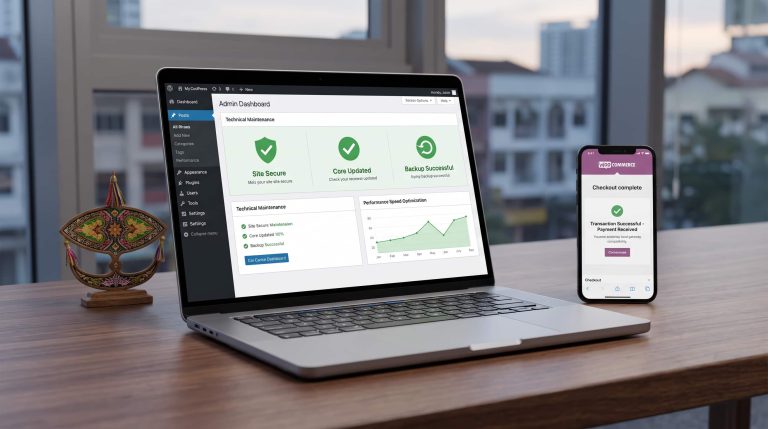
A small business website is also a small business asset that can be attacked or misused. CPA Australia’s 2026 survey found 35 percent of small businesses in the Asia-Pacific region lost time or money to a cyber-attack in 2025, and only 39 percent had reviewed their cybersecurity protections in the past six months, one of the weaker results among the markets surveyed. For a small business website, practical protection does not need to be complicated. It usually comes down to keeping the website platform and plugins updated, using strong and unique admin passwords, enabling an SSL certificate, taking regular backups, and limiting who has admin access.
Pair this with the privacy basics from Section 3, a visible privacy policy and honest handling of any personal data collected through forms, and most small businesses meet what customers and regulators now expect without needing a dedicated compliance team.
7. Watch the real cost, not only the package price
An affordable website setup should still be transparent. Check whether domain, hosting, SSL, design, copywriting, mobile responsiveness, SEO basics, analytics, and handover support are included. A cheap website can become expensive if every essential item is an add-on, or if security and backups are left out entirely.
DigitalBina helps small and growing Malaysian businesses plan, design, build, and improve websites with clear structure, mobile-friendly UX, SEO basics, hosting guidance, analytics setup, and handover support. If you want a clearer starting point, compare website pricing or request a free website audit.
FAQs about small business websites
What should a small business website include?
It should include clear services, honest trust signals, a visible privacy policy, contact options, mobile-friendly design, SEO basics, and simple tracking.
Is WhatsApp enough as the only contact option?
WhatsApp is useful, but keep a form, phone number, or email too if your customers include corporate or higher-ticket buyers.
Do AI Overviews and AI search change what a small business website needs?
Yes, in practice. A complete Google Business Profile, consistent business details across the web, and basic schema markup now influence whether your business gets mentioned in an AI-generated answer, not just where you rank in a traditional list of links.
Does my small business need a Data Protection Officer under PDPA?
Only if you process personal data at the volumes set out in Malaysia’s PDPA amendments, generally large-scale or sensitive data processing. Most small businesses will not meet that threshold, but every business collecting contact details through a website should still publish a clear privacy policy.
Can I start small and improve later?
Yes. Start with the essential pages and a clean structure, then add SEO content, case studies, blog posts, automation, or ecommerce features later.