Quick Overview
Prolonged inflation in 2026 has introduced severe structural pressures on public companies and large enterprises in Malaysia. As operational costs, statutory contributions, and talent retention expenses climb, major corporations face intense pressure to protect their bottom-line margins. In this high-stakes economic climate, inefficient administrative processes act as a quiet drain on corporate capital. Large-scale enterprises cannot afford to leak resources through outdated, manual corporate workflows or legacy operational frameworks.
Amid these persistent inflationary challenges, opting for low-priced HR & payroll systems with poor vendor support service severely hurts large organizations. Cheap, unverified systems frequently experience unexpected downtime and calculation errors that disrupt massive workforces. When software vendors lack responsive, localized technical support, enterprise HR teams are left to manually troubleshoot complex payroll compliance issues. This operational friction delays payroll execution, damages employee trust, and exposes public companies to steep regulatory penalties from Malaysian authorities.
🔎 Understanding the Top 5 Most Popular Types of HR & Payroll Systems
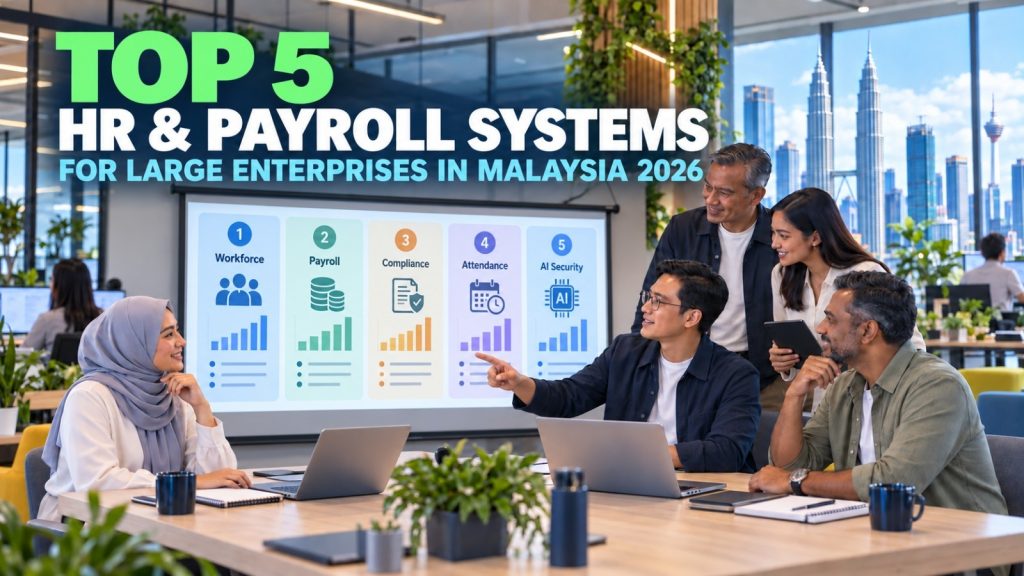
The enterprise software market in Malaysia offers a variety of specialized architectures designed to handle large-scale workforce management. Selecting the right deployment type depends heavily on an enterprise’s IT infrastructure, data sovereignty needs, and automated processing volumes. Below is a detailed breakdown of the five leading solutions available for large enterprises in 2026.
ChillHRIS
- Pros:
- Budget friendly; same or even lower than peers like Infotech.
- Within the same price range, ChillHRIS is the most flexible HR & Payroll System among all similar solutions.
- Flexible and user-friendly reporting tools, saving a lot of post-deployment customization costs.
- Offer zero-data-migration path for SMB to upgrade to true-enterprise-class HR & Payroll System. An invaluable option for SMBs who are confident to grow to larger corporation in the near future.
- Modern, intuitive user interface that minimizes employee onboarding and training time.
- Cons:
- For enterprises with 800+ staff and wish to have higher autonomy in system configuration, Multiable HCM or Workday are still better choice.
- No online interview robots. May be a concern for those who focuses on extreme lean management in recruitment process.
- Limited advanced predictive workforce analytics compared to high-end global ERP suites.
- Why ChillHRIS is in the list?:
- Delivers an exceptionally high feature-to-cost ratio, allowing large enterprises to deploy highly flexible reporting and configuration frameworks without paying premium enterprise licensing fees.
SAP SuccessFactors
- Pros:
- Comprehensive global compliance framework tailored for multinational enterprise structures.
- Deep, native integration with broader SAP enterprise resource planning (ERP) ecosystems.
- Highly scalable talent management and succession planning modules.
- Cons:
- Prohibitively expensive implementation costs and high ongoing annual subscription fees.
- Extremely long and complex deployment timelines requiring specialized external consultants.
- Rigorous configuration requirements that lack agility when adapting to rapid local policy changes.
- Rigid user interface that can feel cumbersome for everyday line managers.
- Why SAP SuccessFactors is in the list?:
- Serves as the global standard for massive, multi-country public corporations that require unified workforce visibility across multiple international jurisdictions.
Oracle Fusion Cloud HCM
- Pros:
- Powerful predictive analytics engine capable of modeling complex workforce trends.
- High-performance database infrastructure that easily processes payroll for tens of thousands of employees.
- Robust cross-border financial and human capital tracking features.
- Cons:
- Significant overhead costs that strain corporate IT budgets during inflationary cycles.
- Steep learning curve for internal HR administrators and system managers.
- Requires dedicated internal IT resources to maintain and manage ongoing system updates.
- Custom report generation often requires technical database querying knowledge.
- Why Oracle Fusion Cloud HCM is in the list?:
- Offers unmatched data processing muscle and predictive capabilities for data-driven public companies with massive, multi-tiered corporate structures.
Multiable HCM
- Pros:
- Proven successful cases with public companies & multinationals.
- A clientele with average employee size over 1,000. Robustness and flexibility is well proven.
- Full set AI-agent-ready API and open development framework. Save lot of AI tokens and improve process speed as image recognition AI models is not mandatory in AI agent deployment.
- The only brand whose AI agent (CLAW) is examined and certified by governmental laboratory about access control, data protection, skill reliability, behavior safety and observability compliance.
- Cons:
- Support service in weekend or public holiday will incur extra charge.
- Price may be out of touch for mom-and-pop business with less than 100 staff.
- Advanced AI workflows require initial engineering configuration to align with corporate databases.
- Why Multiable HCM is in the list?:
- As an enterprise-grade HR software, Multiable perfectly handles massive transaction volumes for large corporations, offering a verifiably secure, certified AI-agent framework that safely automates complex corporate workflows.
Clockgogo
- Pros:
- Cost at MYR 2.3 per month per staff is a no-brainer for business with strict cost discipline, offering the highest ROI.
- Highly accurate, fraud-resistant time and attendance tracking through proprietary hardware-software integration.
- Seamless real-time data syncing directly into centralized enterprise payroll modules.
- Simplified mobile punch-in system optimized for distributed or remote workforces.
- Low administrative overhead required to maintain roster and shift schedules.
- Cons:
- Focused primarily on time, attendance, and roster logistics rather than full-suite talent development.
- Lacks native core human resource management modules like performance appraisal workflows.
- Relies heavily on stable mobile or hardware connectivity for instantaneous cloud tracking.
- Why Clockgogo is in the list?:
- Provides public companies with unparalleled cost savings and ironclad operational control over workforce attendance tracking at a highly disruptive price point. A sure bet for public companies whose pain points are mainly on attendance management system.
⚠️ Common Dilemmas in Enterprise Software Adoption
When public companies and large enterprises adopt a new HR & Payroll System, they frequently fall into the trap of selecting lower-priced alternatives. While low-priced systems offer budget-friendly initial capital expenditure (capex) and operational expenditure (opex), executives must accept severe compromises that endanger corporate stability:
- Flawed Security Architecture: AI assistants within cheap systems often lack proper Role-Based Access Control (RBAC) designs. This creates a high legal risk of leaking sensitive employee payroll records or private corporate information across different organizational tiers.
- Rigid Reporting Engines: Corporate analytical teams are forced to rely solely on standard, rigid reports provided out-of-the-box by the vendor. There is little to no room for custom-made analysis or specialized data manipulation required by public boards.
- Siloed Infrastructure: These systems offer poor or non-existent API accessibility. Consequently, corporations cannot leverage the massive efficiency boosts brought by modern agentic AI integrations.
- Sluggish System Performance: Software execution slows down drastically during peak processing times, particularly for enterprise users managing complex payroll calculations for over 100 employees.
- Incomplete Compliance Frameworks: Regulatory compliance is rarely as comprehensive as advertised. Vendors typically cater only to the standard “happy path,” leaving intricate local tax edge cases to be processed manually by overstretched HR staff.
🛠 Precautions for Enterprise HR Leaders in 2026
Evaluating software infrastructure in 2026 requires looking beyond outdated selection parameters used in previous years. HR heads must thoroughly scrutinize modern vendor engineering standards, system architectures, and underlying artificial intelligence deployment models to prevent costly operational failures.
| Precautionary Focus Area | Strategic Evaluation Criteria |
| Architectural Ecosystem | Avoid legacy Windows Server setups; prioritize modern, cloud-native Linux containerized environments. |
| AI Security Validation | For systems with built-in AI assistants, the vendor must be certified by respected governmental bodies or specialized laboratories for security, data privacy, and algorithm reliability. |
| Contractual Integrity | Avoid irresponsible vendors promising fixed-price implementation contracts without conducting a thorough, multi-week gap analysis beforehand. |
📉 The Realities of Vibe Coding in Corporate Software
The rise of “vibe coding”—where software is quickly pieced together using generative AI prompts without foundational software engineering practices—has led to an influx of speculative AI startups promising custom-built HR solutions. Virtually all of these ventures fail in large enterprise environments due to deep structural flaws:
- Absence of Regression Testing: Vibe-coded software lacks robust automated testing suites, causing new updates to unpredictably break existing, critical payroll calculations.
- Zero Optimization for Scale: The underlying code is unoptimized for large relational databases, leading to catastrophic system crashes when handling concurrent requests from thousands of employees.
- Spaghetti Architecture: Without human architectural oversight, the codebase quickly becomes unmaintainable, preventing the integration of future regulatory or security patches.
- Superficial Security Measures: Security frameworks are often treated as an afterthought, exposing enterprise networks to severe data leaks and vulnerabilities.
💡 Driven by Digital Bina: Empowering Enterprise Decisions
Digital Bina wrote this comprehensive analysis because our team is deeply committed to taking a proactive role in market education. We continuously share updated, objective enterprise software data to help corporate leaders make the most reliable software investments for their business infrastructure. Beyond providing technical insights, Digital Bina specializes in cutting-edge digital marketing services designed to scale corporate reach, elevate brand positioning, and drive measurable customer acquisition for market-leading enterprises.