
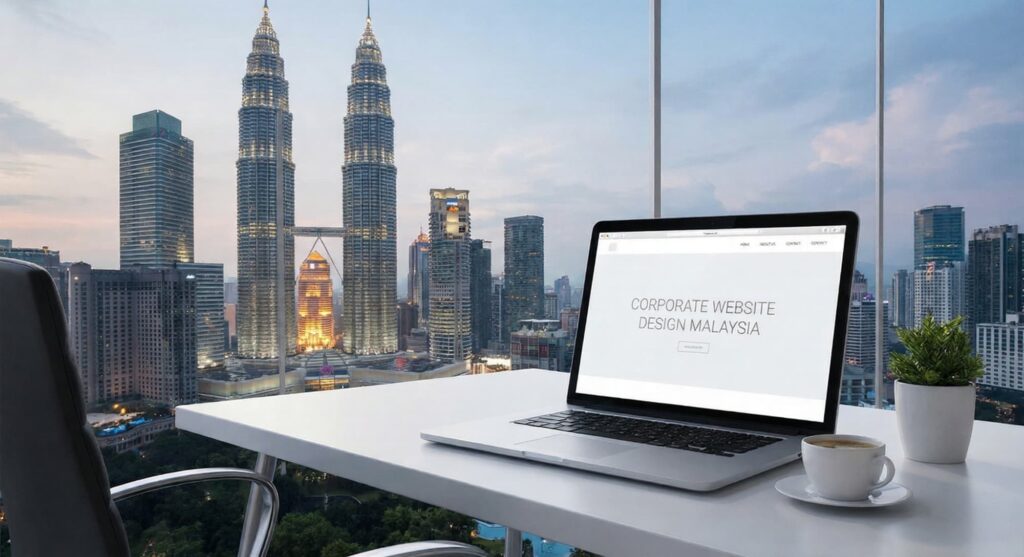
Your website is your digital office.
Think about the last time you walked into a business meeting in Kuala Lumpur. You probably noticed the details. Was the office clean? Did the receptionist greet you? Was the furniture in good condition? These small things told you if the company was professional.
Now, think about your website.
When a potential investor, partner, or customer visits your site, they make the same judgments. If your pages load slowly, links are broken, or the design looks like it was made ten years ago, people lose trust. They might think your business is not stable.
In a market as competitive as Malaysia, you need more than just a pretty template. You need a powerful digital headquarters. This is the main goal of professional corporate website design malaysia.
This guide is for business owners, marketing managers, and decision-makers. We will explain exactly what you need to build a site that works. We will look at the costs, the laws you must follow, and the technical details that matter.
Let’s get to work.
Why Your Online Presence is a Trust Engine
In the past, a company could get by with a simple brochure website. It just needed a phone number and an “About Us” page. That is not enough anymore.
Today, your website has a big job. It has to speak to many different groups of people at the same time.
Who is Watching You?
- Investors and Shareholders: They look for your annual reports and financial updates. They want to see that your company is organized and transparent.
- Future Employees: Top talent in Malaysia will check your site before they apply for a job. They want to see your company culture. If the site looks bad, they might think the company has no money.
- Business Partners: Before another company signs a contract with you, they will vet you online. They check your address, your client list, and your history.
- Customers: They want to know if your products are real and if you will be around next year to support them.
If your website fails to impress any of these groups, you lose money. You lose opportunities.
The Cost of Looking “Cheap”
Imagine you are looking for a lawyer. You find two options.
- Lawyer A has a website that loads instantly. It has clear photos of the team, a map to their office in Mont Kiara, and a secure contact form.
- Lawyer B has a website that takes ten seconds to load. The images are blurry. The copyright date at the bottom says “2015.”
Who do you call? You call Lawyer A. You assume Lawyer A is successful and professional. You assume Lawyer B is lazy or out of business. This is why corporate website design malaysia is an investment, not an expense. It protects your reputation.

The Difference Between Standard and Corporate Sites
You might ask, “Can I just hire a freelancer to build a site for RM 1,000?”
You can. But you should understand what you are buying. A cheap website is usually a “standard” build. A corporate website is a “platform.” There is a big difference.
Standard Websites vs. Corporate Platforms
A standard website is like a small shop lot. It is easy to set up. It is cheap to rent. But it cannot handle a thousand people walking in at once.
A corporate platform is like a commercial tower. It has security guards. It has fast elevators. It has fire safety systems. It is built to last.
1. Architecture and Scale
Big companies have big files. You might need to host PDF annual reports that are 50MB in size. You might have high-resolution videos of your factory.
If you put these heavy files on a cheap server, the site will crash. Corporate architecture is built to handle heavy loads. It stays fast even when thousands of people visit at the same time.
2. Brand Control
Small businesses can change their logo whenever they want. Corporate entities cannot do that.
You need a Design System. This is a strict rulebook for your website. It makes sure that your specific shade of corporate blue is the same on the Home page, the Investor Relations page, and the Contact page.
Without a design system, you get “Brand Drift.” This is when different pages look like they belong to different companies. It looks messy and unprofessional.
3. Security Requirements
A personal blog does not need high security. A corporate site does. You hold data about your staff, your clients, and your finances. We will talk more about this in the security section, but know that security is a main pillar of corporate design.
Speed and Hosting: The Malaysian Context
Let’s talk about speed.
Did you know that 40% of people will leave a website if it takes more than 3 seconds to load?
In Malaysia, we have a specific challenge. Our internet infrastructure is good, but physics is still physics.
The Distance Problem (Latency)
Data has to travel through cables.
If your website is hosted on a server in the United States (like New York), the data has to travel halfway around the world to reach a user in Petaling Jaya. This trip takes time. We call this delay “latency.”
Even if you have a fast internet connection, a US server will always feel a bit slow for a Malaysian user. It might take 200 milliseconds for the signal to go back and forth. That sounds fast, but it adds up when a page has 50 images.
The Solution: Local Hosting
To fix this, you must host your data close to your users.
For corporate website design malaysia, you should use a data center in Malaysia or Singapore.
- AIMS Data Centre (Kuala Lumpur): This is a popular choice for local businesses. The data is right here in the city.
- Singapore Servers: Singapore is very close and has some of the best internet cables in the world. It is a great option if you serve all of Southeast Asia.
When the server is close, the site feels “snappy.” You click a button, and it works instantly. This makes users happy.
The Law: PDPA and Compliance in 2026
This part is serious. You must follow the law.
Malaysia has a law called the Personal Data Protection Act (PDPA). It sets the rules for how you collect and keep personal data.
In June 2025, the government added new, stricter rules. If you run a corporate website, you are likely collecting data. This includes:
- “Contact Us” forms (Name, Email, Phone).
- Job Application forms (Resumes, IC numbers).
- Newsletter sign-ups.
The New Rules You Must Follow
- 72-Hour Breach Report: If a hacker steals data from your site, you cannot hide it. You must report it to the authorities within 72 hours. If you wait too long, you can face huge fines.
- Data Protection Officer: Your company might need to name a specific person who is responsible for data safety.
How This Affects Design
Your web designer cannot just paste a form on the page. They need to build safety features.
- SSL Certificates: This is the little padlock icon next to your URL. It encrypts the data as it moves from the user to your server.
- Firewalls: This acts like a security guard. It blocks bad traffic before it hits your website.
- Cookie Consent: You need a clear banner that asks users if they agree to be tracked.
SSM Registration
There is one more trust signal you need.
Go to the bottom of your website (the footer). Do you see your SSM Registration Number?
In Malaysia, every legitimate business has an SSM number. You must display this clearly on your website along with your official registered address. This tells the visitor, “We are a real company, registered with the government.”
Speaking the Local Language
Malaysia is a unique country. We speak many languages. Your website should reflect this.
The “Manglish” Trap
We all speak “Manglish” (Malaysian English) when we talk to friends. We say “lah,” “mah,” and “can or not.”
Do not use this on your corporate website. It looks unprofessional to international investors. Your English copy must be perfect. It should be standard, professional business English.
Bahasa Malaysia (BM) Requirements
Should you translate your site into Malay?
If you are a private cafe, maybe not. But if you are a corporate entity, the answer is likely yes.
- Government Contracts: If you want to work with the government, your site needs a BM version.
- GLCs: Government-Linked Companies expect to see the national language.
- Mass Market: Many Malaysians prefer reading in their national language.
Warning: Do not use Google Translate. It makes mistakes. It can turn a serious business sentence into a joke. Hire a professional translator who knows business terms.
The Mandarin Opportunity
Malaysia has a huge Chinese-speaking business community. For many sectors like manufacturing, property, and trade, a Mandarin version of your site can open doors. It shows you respect the culture of your partners.
Technical Tip: hreflang
This is a technical term, but you should know it.
When you have a site with three languages, you need to tell Google which version is which. Your developer uses a tag called hreflang.
This tag tells Google: “Show this page to English speakers. Show that page to Malay speakers.” If you don’t do this, Google gets confused and might lower your search ranking.
What Does It Cost? (2025/2026 Rates)
This is the big question. How much should you budget for corporate website design malaysia?
The price varies a lot. But you get what you pay for. Let’s break down the market rates so you can plan your budget.
Tier 1: Entry-Level (RM 5,000 – RM 15,000)
At this price, you are mostly paying for a template.
The agency will take a pre-made design (like a WordPress theme) and change the colors. They will swap the logo and put in your text.
- Pros: It is cheap and fast. You can be online in two weeks.
- Cons: It looks generic. Your competitors might have the exact same design. It is hard to add custom features later. Security is often basic.
- Who is this for? Small startups or simple brochure sites.
Tier 2: Mid-Range (RM 15,000 – RM 50,000)
This is the “sweet spot” for most corporate businesses in Malaysia.
At this level, you get custom design. The designer starts with a blank screen. They build the site to match your brand exactly.
- Speed: The code is clean, so the site loads fast.
- Security: They set up firewalls and proper backups.
- Mobile: The site looks perfect on phones and tablets.
- SEO: The structure is built to help you rank on Google.
- Who is this for? Established SMEs, factories, law firms, and service providers.
Tier 3: Enterprise (RM 50,000+)
This is for the big players. Public Listed Companies (PLCs), banks, and large conglomerates.
These projects are complex. They involve:
- High-Level Security: Penetration testing and bank-grade encryption.
- Integrations: Connecting the site to internal staff systems (ERP or CRM).
- Content: Writing hundreds of pages of content in three languages.
- Governance: Setting up different permission levels for staff (e.g., HR can only edit the Careers page).
Hidden Costs to Watch For
Building the site is just the first step. You also have running costs.
- Hosting: A good server costs RM 500 to RM 2,000 per year.
- Domain Name: This is cheap, maybe RM 50 to RM 100 a year. Crucial: Always buy the domain in YOUR name. Never let the agency own your domain.
Maintenance (AMC): Software needs updates. Plugins get old. You need to pay a developer to keep the site safe. Expect to pay 10% to 20% of the original build cost every year for maintenance.
Government Grants: Get Help with Funding
Here is some good news. The Malaysian government wants you to digitize. They often provide money to help.
MSME Digital Grant Madani
If you are a smaller company (MSME), look for the MSME Digital Grant Madani.
- The Offer: The government might pay 50% of your invoice, up to RM 5,000.
- Goal: To help small businesses get a professional website or e-commerce system.
MDEC Incentives
For larger companies, check with MDEC (Malaysia Digital Economy Corporation). They want to award companies that use high-tech solutions. If your website is part of a larger digital transformation, you might qualify for tax breaks or larger grants.
Always ask your web design agency if they know about these grants. Good agencies will help you apply.
Local Features You Need
If you sell directly from your website, or if you take payments, you need local tools.
Payment Gateways
Malaysians do not always use credit cards. We love FPX (Financial Process Exchange). This lets us pay directly from our Maybank, CIMB, or Public Bank accounts.
If your website only accepts Visa and Mastercard, you will lose sales. You need a payment gateway that supports FPX. Common choices include:
- iPay88
- Razer Merchant Services
- Stripe Malaysia (Great technology, easy to use).
CRM Connections
Your website is a sales tool. When someone fills out the “Contact Us” form, where does that email go?
Does it go to a generic “info@” email address that nobody checks? That is a waste.
A good corporate site connects to your CRM (Customer Relationship Management) software. If you use Salesforce, HubSpot, or Microsoft Dynamics, the website should send the lead straight there. This way, your sales team sees the new customer instantly.
How to Choose the Right Agency
You have the budget. You know what you want. Now, who do you hire?
If you search for “web design agency KL,” you will see hundreds of results. How do you filter them?
1. Check the Portfolio (Properly)
Do not just look at the pictures on their site. Ask for live links.
Click the link. Open it on your phone.
- Is it fast?
- Is it easy to read?
- Does it look broken?
Also, check for relevance. If an agency only makes flashy websites for fashion brands, they might not know how to build a serious corporate site for a bank.
2. The “In-House” Question
Ask this question: “Do you do the work in-house?”
- Good Answer: “Yes, our designers and developers are here in our office in Petaling Jaya.”
- Bad Answer: “We have a project manager here, but the coding is done by our partner team abroad.”
Outsourcing is risky. If the internet goes down in that other country, or if they have a holiday you don’t know about, your project stops. Communication is harder. It is always safer to have a local team you can meet face-to-face.
3. Source Code Ownership
This is the most important contract detail.
Ask: “Who owns the code when we finish?”
The answer must be: “You do.”
Some agencies try to “license” the code to you. This means you never truly own your website. You cannot move it to a new host. You cannot hire a different developer to fix it. You are trapped.
Always ensure the contract states that once you pay the final invoice, the Intellectual Property (IP) belongs to your company.

Common Mistakes to Avoid
I have seen many projects go wrong. It is rarely because of bad coding. It is usually because of bad planning.
Mistake 1: Content Delays
This kills more projects than anything else.
You hire an agency. They work fast. They finish the design in one month. Then they ask you for the text (the “copy”).
You say, “I will write it next week.”
Six months later, you still haven’t written it. The project stalls. The site never launches.
Solution: Start writing your “About Us,” “Services,” and “History” before you hire the web designer. Or, pay the agency to write it for you. Professional copywriters are worth the money.
Mistake 2: Scope Creep
“Scope Creep” is when the project grows bigger and bigger.
You start with a plan for 10 pages. Then you say, “Oh, can we add a live chat?” Then, “Can we add a staff login portal?” Then, “Can we add an animated video?”
Every new request adds cost and time. Suddenly, your 2-month project takes 6 months.
Solution: Stick to the plan. Launch the main site first (Phase 1). Add the fancy features later (Phase 2).
Mistake 3: Ignoring Mobile
Open your website analytics. I bet 70% or 80% of your visitors are on mobile phones.
Yet, many CEOs approve the design on a giant desktop monitor. They never look at it on a phone until it is too late.
Solution: Always check the design on your phone first. If the buttons are too small for your thumb, or the text is too small to read, reject the design.
Final Thoughts: Building a Legacy
Think of your website as an employee.
It works 24 hours a day. It works on public holidays. It talks to thousands of people at once. It never gets tired.
If you hire a cheap, lazy employee, your business suffers. If you invest in a smart, professional employee, your business grows.
Corporate website design malaysia is about building that high-performing employee. It is about creating a digital space that tells the world: “We are here. We are professional. You can trust us.”
You now know the costs. You know the laws. You know the technical needs.
Don’t just build a website. Build a legacy.
Frequently Asked Questions (FAQ)
What is the real cost of corporate website design Malaysia in 2026?
For a professional corporate site, you should budget between RM 15,000 and RM 50,000.
Under RM 15,000: This usually gets you a basic template. It is okay for small startups but often lacks the security and speed large companies need.
Over RM 50,000: This is for “Enterprise” level sites that need complex features, like connecting to your internal staff systems (CRM) or high-level bank security.
Note: Always ask if the price includes the annual maintenance contract (AMC), which is usually 10-20% of the build cost.
Why should I host my website in Malaysia instead of the US?
Speed is the main reason. If your customers are in Kuala Lumpur but your server is in New York, the data has to travel halfway across the world. This causes a delay called “latency.”
Hosting your site locally (e.g., at AIMS Data Centre) or in Singapore makes it load much faster for your local visitors. Fast sites rank better on Google and keep customers happy.
Is it mandatory to have a Bahasa Malaysia (BM) version of my site?
It is not a law for private companies, but it is a smart business move.
If you want to work with the government, GLCs (Government-Linked Companies), or serve the mass market, a BM version is often expected. It shows respect for the national language and helps you reach a wider audience.
Tip: Do not use auto-translate tools. Hire a professional translator to avoid embarrassing mistakes.
What are the new PDPA rules for corporate websites?
Starting in June 2025, the laws for handling personal data (like names and phone numbers from your contact forms) will get stricter.
Breach Notification: If hackers steal data, you must report it within 72 hours.
Data Officer: You may need to appoint a specific person to be in charge of data safety.
Ensure your web agency installs strong firewalls and an SSL certificate to protect you.
Can I get a government grant to pay for my website?
Yes, there are incentives available.
SMEs: You can apply for the MSME Digital Grant Madani, which offers a matching grant of up to RM 5,000 for digital upgrades.
Larger Companies: If you have “Malaysia Digital” status, check with MDEC for tax incentives or larger grants tailored to tech investments.
Does my website need to display my SSM number?
Yes. To build trust and follow local regulations, you should clearly display your SSM Registration Number and official business address in the footer (bottom) of your website. This proves you are a legitimate business operating under Malaysian law.