
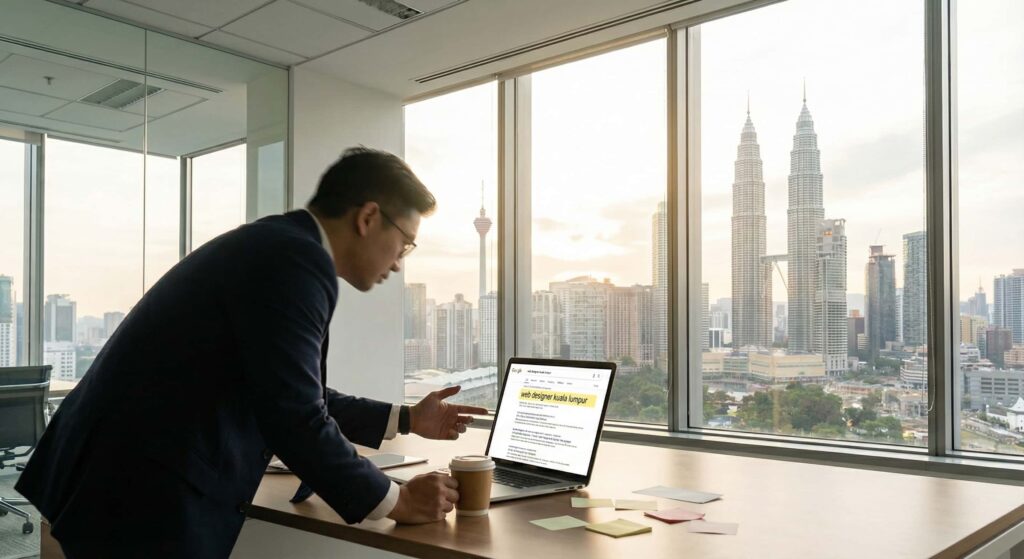
Is your business website actually making you money? Or is it just sitting on the internet collecting dust? 🕸️
If you run a business in Malaysia, this is the most important question you can ask yourself right now. The digital world in Kuala Lumpur moves very fast. A few years ago, having a simple website was enough. It was like having a digital business card. People would see it, nod, and maybe call you.
But today, that is no longer true.
You have thousands of competitors just a click away. Your website needs to be more than just a digital brochure. It needs to be a sales machine. It needs to work 24 hours a day, 7 days a week, to turn visitors into paying customers.
Finding the right web designer kuala lumpur is the first step to fixing this problem. But where do you start? There are so many options out there. You see expensive corporate firms in the city center. You see cheap freelancers working from home. You see ads for “do it yourself” builders. It can be confusing to know who to trust.
This guide will explain exactly how to find a partner who understands your business and the Malaysian market. We will look at real costs, what services you actually need, and how to avoid getting ripped off. Whether you are in the city center or looking for web design johor bahru, the rules for success are the same.
Let’s look at how you can build a site that works.
Why Local Matters: The Case for a KL-Based Partner
You might be thinking, “Why can’t I just hire someone from a freelance website for RM 200? They live in another country, but they are cheap.”
You certainly can do that. But have you ever tried to explain a complex business problem to someone who lives in a different time zone? Have you tried explaining how DuitNow or FPX works to someone who has never heard of them?
It can be very frustrating. 😫
Hiring a local expert—whether it is an individual or a professional web design agency—gives you a huge advantage. Location matters more than you might think. Here is why working with someone in Malaysia saves you time and money in the long run.
1. Understanding the Malaysian User
Malaysian customers are unique. We don’t shop exactly like people in the USA, Europe, or even Singapore. A local designer knows the small details that make a big difference in sales.
WhatsApp is King
In many Western countries, people use email contact forms. They fill out a box and wait 24 hours for a reply. In Malaysia, we hate waiting. If you don’t have a floating WhatsApp button on your site, you are losing sales.
People want to chat now. They want to ask, “Do you have stock?” or “Can you deliver to Petaling Jaya by tomorrow?”
A web designer kuala lumpur knows this is mandatory. They will not just put a button there; they will program it to open the app on the customer’s phone immediately. A designer from Europe might tell you WhatsApp is “unprofessional.” A local designer knows it is how business gets done here.
Dual-Language Needs
Malaysia is a multicultural country. Depending on who you sell to, you might need your site in both English and Bahasa Melayu. You might even need Chinese.
This is not as simple as using Google Translate. The layout of the page changes when the language changes. A local pro knows how to set this up so it switches smoothly without confusing the user. They understand that your headlines need to make sense in our local context, not just in a textbook way.
Mobile-First Habits
Did you know that over 80% of Malaysians visit websites on their phones, not computers?
We are always on our phones. We shop while stuck in traffic on the Federal Highway. We look for restaurants while riding the LRT.
A local designer prioritizes the “mobile view” over the desktop view. They make sure the buttons are big enough for thumbs. They make sure the text is easy to read on a small screen. If your site looks good on a laptop but bad on a phone, you will lose almost all your customers.
2. Trust and Safety
Trust is hard to earn online. When you hire locally, you have accountability. You can meet them for coffee in Bangsar South. You can visit their office in KL Sentral. You know they are real people.
SSM Registration
A legitimate local designer will make sure your website displays your SSM (Suruhanjaya Syarikat Malaysia) registration number in the footer.
Why does this matter? Because Malaysian shoppers are scared of scams. When they see an SSM number, they feel safer. They know you are a real business registered with the government. A designer from another country will not know to include this.
PDPA Compliance
You also need to follow the law. Malaysia has a law called the Personal Data Protection Act (PDPA). It sets rules on how you handle customer data like names and phone numbers.
A local web design agency will know how to write a Privacy Policy that follows these laws. This keeps you out of legal trouble. It also tells your customers that you respect their privacy.
Key Point: A cheap website from overseas might save you money today. But it will cost you sales tomorrow if it doesn’t fit the local culture.

Core Services: What Should You Actually Pay For?
When you hire a web designer kuala lumpur, you aren’t just paying for pretty colors and pictures. You are paying for technology that works.
Tech talk can be boring. Designers often use big words to confuse you. Here are the technical terms explained in simple English.
The “WordPress” Advantage
You will hear the word WordPress a lot. It is a system used to build websites.
Why use it?
It powers about 65% of business websites in Malaysia. It is the standard for a reason.
The benefit for you:
It is easy to use. Once the designer finishes the job, they hand the keys to you. You (or your staff) can log in easily. You can change text, update prices, or add new photos. You do not need to know how to write code.
If you hire someone who builds a “custom coded” site from scratch, you are trapped. Every time you want to change a comma, you have to pay them. With WordPress, you have freedom.
eCommerce and Payments (Getting Paid.) 💸
If you want to sell products online, you need a “Payment Gateway.” This is the software that processes credit cards and online banking. This is where local knowledge is critical.
The Local Necessity: FPX
Your designer must know how to integrate FPX (Online Banking).
Malaysians love using Maybank2u, CIMB Clicks, and Hong Leong Connect. We prefer it over credit cards. If you only offer PayPal or credit cards, many locals will abandon their cart. They will see the checkout page, realize they can’t use their bank, and leave.
Popular Gateways
Ask your designer if they have experience with these local providers:
- iPay88: Very popular and trusted.
- Razer Merchant Services: Used by 7-Eleven and many big shops.
- Stripe: A modern option that now supports FPX.
If your designer suggests a gateway that does not support FPX, they do not understand the Malaysian market.
Local SEO (Being Found on Google)
A beautiful website is useless if no one can find it. You want to show up when people search for things like “Best bakery near me” or “Plumber in KL.”
Google Maps Optimization
A good designer will help set up your “Google Business Profile.” This is the map listing that shows up at the top of Google search results.
This is vital for local traffic. If you are a local business, this map listing is often more important than your main website link. Your designer should know how to connect your website to this map listing so they work together.
Agency vs. Freelancer: Which Fits Your Business?
Should you hire a big company or a single person? Both have pros and cons. It usually depends on your budget and how big your project is.
The Freelancer 👤
A freelancer is a single person who does everything. They design the look. They write the code. They might even write the text for you.
Pros:
- Cost: They are usually cheaper because they don’t have an office to pay for.
- Personal: You talk directly to the person doing the work. You don’t have to go through a secretary or manager.
Cons:
- Reliability: This is the biggest risk. What if they get sick? What if they go on holiday? You are left with no support.
- Skill Gaps: It is rare to find one person who is great at design AND coding AND writing. Usually, they are good at one thing and just okay at the others.
Best for:
Small projects, personal sites, simple landing pages, or tight budgets.
The Web Design Agency 🏢
An agency has a full team. They have a designer who draws the pictures. They have a coder who writes the software. They have a project manager who talks to you. They have a writer who checks the spelling.
Pros:
- Reliability: If one person is sick, someone else takes over. Your project does not stop.
- Experts: You get a specialist for every part of the job. The design looks better, and the code runs faster.
Cons:
- Cost: It costs more. They have to pay a whole team and rent an office.
- Process: It might take a bit longer because they have more steps and checks.
Best for:
Growing SMEs, eCommerce stores, and companies that cannot afford for their website to be offline.
Note: Whether you are in KL or searching for web design johor bahru, the choice depends on your budget and how much risk you can handle.
Investment Guide: Web Design Pricing in Kuala Lumpur (2026/2027)
This is the part everyone wants to know: “How much will it cost?”
Pricing can be confusing because every project is different. You might call one place and hear “RM 1,000,” and call another and hear “RM 10,000.” Why is the difference so big?
To make it simple, we have broken it down into three levels based on current market rates in Kuala Lumpur. Use this table to plan your budget.
1. The Starter Package
Estimated Cost: RM 1,500 – RM 3,500
Who is this for?
New startups, personal blogs, or simple portfolios.
What you usually get:
- Template Design: They use a pre-made design. They change the colors and logo, but the layout stays the same.
- Up to 5 Pages: Home, About, Services, Contact.
- Basic Mobile Friendly: It works on phones, but it might not be perfect.
- Contact Form: A simple box for people to email you.
The downside:
It looks like many other websites. It might be hard to add new features later.
2. The Business (SME) Package
Estimated Cost: RM 5,000 – RM 12,000
Who is this for?
Established businesses looking for more leads and sales. If your business depends on customers finding you online, this is where you should start.
What you usually get:
- Custom Design: A unique look built just for your brand.
- SEO Setup: They set up the technical parts so Google can read your site.
- WhatsApp Integration: The chat button we talked about earlier.
- Speed Optimization: They make sure the site loads fast (under 3 seconds).
- Google Analytics: A tool to see how many people visit your site.
The upside:
This website is built to sell. It looks professional and trustworthy.
3. The Enterprise Package
Estimated Cost: RM 15,000 – RM 50,000+
Who is this for?
Large companies or big online stores with many products.
What you usually get:
- Advanced eCommerce: Systems like WooCommerce or Shopify set up for thousands of products.
- Payment Gateway Setup: Connecting FPX, Credit Cards, and E-wallets.
- Membership Systems: If you need people to log in to see content.
- Custom Software: Connecting your website to your inventory system or accounting software.
Why is the price difference so big?
Think of it like building a house. 🏠
- The Starter is like a prefab cabin. It comes in a box. It is quick to build, but you can’t move the walls. It does the job of keeping the rain out.
- The Business package is like a custom semi-D home. It is built to fit your family perfectly. It has better security, better plumbing, and it looks nicer from the street.
- The Enterprise is like a skyscraper. It requires a team of engineers. It needs strict safety checks. It has complex systems to handle thousands of people at once.
You pay for the complexity and the skill required to build it safely.
Hidden Costs: The “Fine Print” You Must Know
Be careful. The initial price quote is usually just for building the website. There are ongoing costs to keep it running.
A transparent web design agency or freelancer will tell you about these costs upfront. If they don’t mention them, you must ask.
1. Domain Name
This is your address on the internet (e.g., yourbusiness.com.my).
- Cost: RM 60 to RM 120 per year.
- Tip: Try to get a .com or .com.my. These are the most trusted in Malaysia. Avoid strange endings like .biz or .info as they look less professional.
2. Web Hosting
This is the “land” your website house sits on. It is a computer server where your files live.
- Cost: RM 300 to RM 2,000 per year.
- Crucial Tip: Ask your designer, “Where is the server located?”
This is very important. For the fastest speed in Malaysia, the server should be in Singapore or Malaysia.
If they host it in the USA or Europe, your data has to travel halfway around the world every time someone clicks a link. This makes your site slow. A slow site makes customers leave.
3. Maintenance
Websites are like cars; they need oil changes. Software updates come out every month. Hackers are always trying to find new ways to break in.
- Cost: RM 200 – RM 500 per month.
- What it covers: Updating software to prevent hackers, fixing bugs, and making small text changes.
Do you need it? Yes. If you don’t pay for maintenance, your site might break or get hacked after a year. It is cheaper to pay for maintenance than to pay to fix a hacked site.

The Design Process: What to Expect
If you have never built a website before, the process can feel scary. What actually happens? Do you just give them money and wait?
Here is a simple step-by-step list of what usually happens when you work with a professional.
Step 1: Discovery 🕵️
The designer asks you questions.
- Who are your customers?
- Who are your competitors?
- What websites do you like?
- What is the main goal? (Calls? Emails? Sales?)
This is the most important step. If they don’t ask questions, you should run away. How can they build a solution if they don’t know the problem?
Step 2: Wireframing ✏️
Before adding colors, they draw a blueprint. This is called a wireframe. It shows where the buttons, pictures, and text will go.
It looks like a black and white sketch. This is the time to change the layout. It is easy to move a wall on a blueprint. It is hard to move a wall once the house is built.
Step 3: Design & Content 🎨
This is where it gets pretty. They add your logo, your brand colors, and your photos.
You will usually need to provide the text. Most designers are not writers. If you need them to write the text for you, they will charge extra for a copywriter.
Step 4: Development 💻
The coder takes the picture and turns it into a real, working website. They write the code. They connect the buttons. They set up the forms. They make sure the math works for the shopping cart.
Step 5: Testing & Launch 🚀
They check the site on iPhones, Androids, and laptops. They make sure it looks good everywhere. They test the contact form to make sure the email actually gets to you.
Then, they flip the switch and you go live.
Critical Questions to Ask Before Hiring
Don’t sign a contract until you ask these three questions. The answers will tell you if the designer is a pro or an amateur.
Question 1: “Will I own the website completely?”
Good Answer:
“Yes, once you pay the final invoice, you own the source code, the domain, and all images. We will give you the login details.”
Bad Answer:
“No, the website belongs to us. You pay a monthly rental fee to use it.”
Why it matters:
You want to own your asset. Avoid “vendor lock-in.” If you rent the site, you can never leave that agency. If you stop paying, they delete your business. Always insist on ownership.
Question 2: “Do you offer on-page SEO?”
Good Answer:
“Yes, we structure the headings properly. We optimize the images so they load fast. We submit your sitemap to Google so it knows you exist.”
Bad Answer:
“SEO is magic” or “I don’t know what that is.”
Why it matters:
A website that Google can’t read is a waste of money. The foundation of the site needs to be built correctly for Google.
Question 3: “What happens if something breaks next month?”
Good Answer:
“We offer a 30-day warranty for free fixes. After that, we have a maintenance plan you can join.”
Bad Answer:
“Once it is launched, you are on your own.”
Why it matters:
Software breaks. It just does. You need to know who to call when it happens. You want a partner who sticks around, not one who takes your money and disappears.
Final Thoughts: Invest in Your Growth
Your website is your best employee. It works 24 hours a day. It never takes a sick day. It never asks for a holiday. It never complains about the traffic on the way to work.
If you view your website as just another “expense” like buying paper clips, you will try to find the cheapest option. You will look for the lowest number.
But if you view it as an investment, you will look for the web designer kuala lumpur who can bring you the best return on your money. A good website pays for itself by bringing in new customers.
Let’s Recap the Rules for Success:
- Go Local: Hire a partner who knows the Malaysian market. They know about FPX payments, WhatsApp buttons, and mobile shopping habits.
- Pay for Value: A professional web design agency costs more because they deliver sales, not just pretty pictures.
- Check the Tech: Make sure the site loads fast. Ask about hosting in Singapore or Malaysia.
- Own It: Never sign a contract unless you keep the domain and the code.
Whether you are a startup in Bangsar or a factory in the south searching for web design johor bahru, the right digital partner is out there.
Are you ready to build a website that actually sells?
Don’t just guess. Start by listing down your business goals. Check your budget against the prices we discussed. Interview at least three local experts. Ask them the hard questions in this guide.
The right partner is out there. Now you know exactly how to find them. 🚀